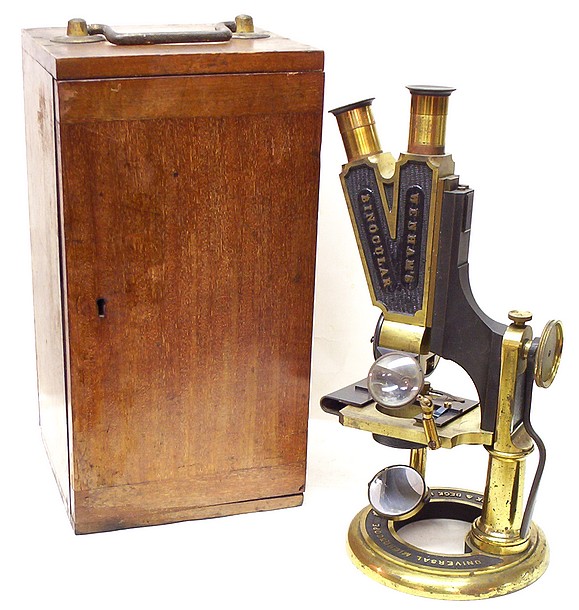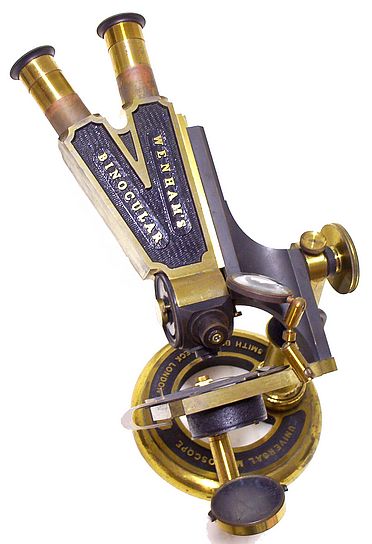
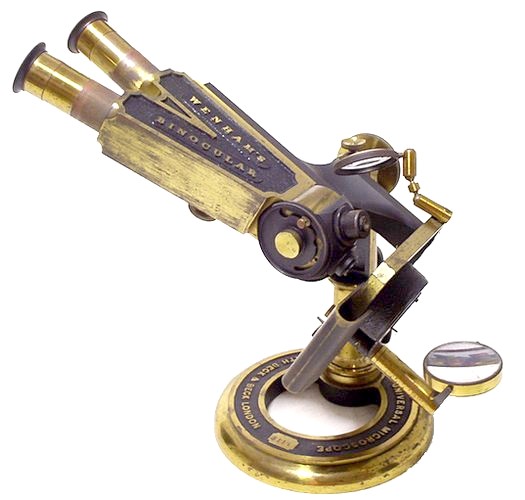
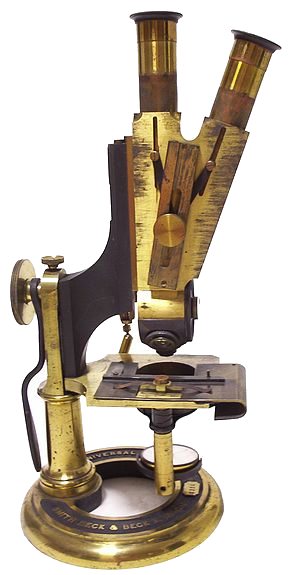
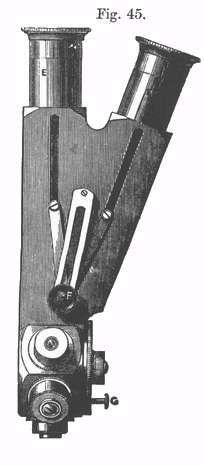
Wenham's Binocular Body for the Universal Microscope.
This Binocular Body (fig. 45), as applied to. the Universal Microscope, possesses the following advantages:- The object-glasses are mounted on a rotating disk, as already described under the combined body; an adjustment for different distances between the eyes is made by turning the milled head (F), which will move the draw-tubes (E,E) up or down. The reflecting prism is placed close behind the back lens of each object-glass, and with this arrangement the field of view is not cut off when the objects ure viewed as transparent, with the highest power.
The change to the binocular body can also be made with the same facility as has been already described under the "combined body."
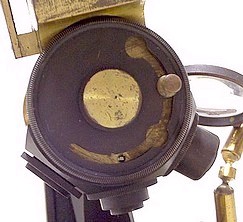
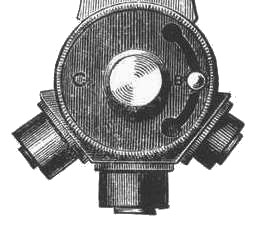
The firm was established by James Smith, one of the three premier English microscope manufacturers of the Victorian era (the two others were A. Ross and H. Powell), around 1839. In 1847 Richard Beck became a partner in the firm and was shortly followed by his brother Joseph Beck in 1857. After the retirement of Smith in 1865, the firm was known as R&J Beck. Read about the Universal Microscope as described in Richard Beck's The Achromatic Microscope, 1865