Bausch & Lomb Optical Co.

Pat. Oct. 3, 1876 and Oct 13, 1885

The Universal Model Microscope, c. 1890

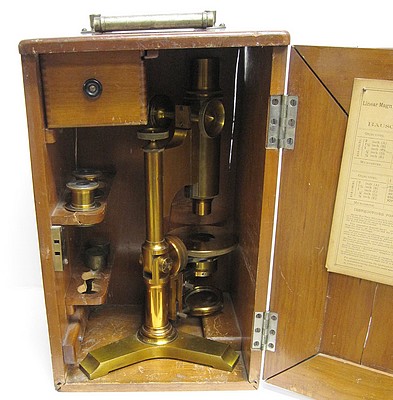
The microscope is signed on the stage Bausch & Lomb Optical Co. It is marked with the above patent dates on the limb (although the patent dates are very lightly stamped and are hard to see). This is a fine example of the B&L Universal model microscope. While the wood storage box is usually is marked with the serial number, in this case, none is present. Nevertheless, the microscope can be dated to around 1890.

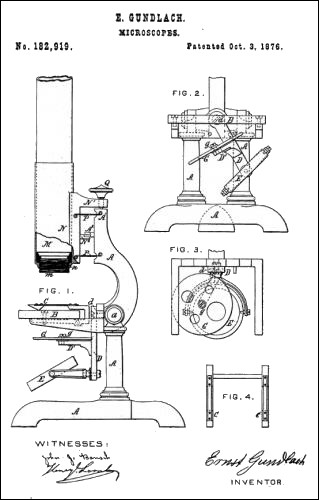
The microscope is constructed entirely of brass having a bright orange-golden lacquer surface finish. The microscope has nickel plated double draw-tubes. With draw-tubes partially extended as shown in some of the photos, the microscope measures about 17-inches tall in the inclined position and about 15-inches with the draw-tubes closed. One of the draw-tubes has a Society Screw on the lower end to accommodate very low power objectives and other accessories. The microscope focuses using a rack and pinion. The fine focus is by micrometer screw and it utilizes the novel mechanism that is a subject of the 1876 patent. An important feature of this model is the independent and calibrated movements of the mirror arm and the condenser arm, an arrangement that supposedly allowed extreme oblique illumination including above-stage illumination.

The microscope comes equipped with two B&L oculars marked A and C, three B&L objectives which include a 2/3-inch, 1/12-inch oil immersion objective, and a 1/4-inch objective. The former two have their brass canister.

Also included are the two stage clips, an Abbe condenser with iris diaphragm, a double objective changer, a camera ludica, an eyepiece shield, a substage adapter with a Society Screw which will allow the use of an objective as a condenser, and a tool to adjust the centering of the substage. In addition, the microscope is equipped with a brass and glass accessory slide carrier having an 1877 patent date (see description below), which is used instead of the stage clips. The mirror is double sided with plane and concave glasses in good condition. The brass stage is capable of a full 360-degree rotation. The microscope is supplied with its wood case having an internal draw, brass handle, lock but no key.

The microscope is in very good condition. All surface finishes are original with only minor blemishes. All mechanics work exactly as they should. The wood case with internal draw is in solid condition with a nice surface, but there are a number of age cracks on the door and back panel mostly due to wood shrinkage. Attached to the inside door is a magnification chart. Some of the internal fitting in the case have been broken, but are now repaired by gluing. This microscope was very well cared for over the years and is a fine example of a classic American made microscope

Price: SOLD

Please include $55.00 for postage and insurance for continental US destinations. Shipping will be at cost if sent elsewhere. Payment should be by Paypal or by check or money order in US funds drawn on a US bank. Contact me at: wissnera@verizon.net
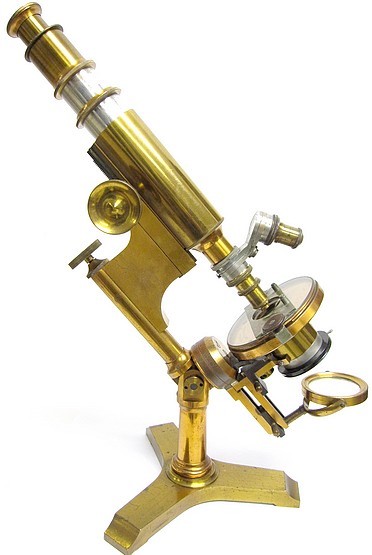
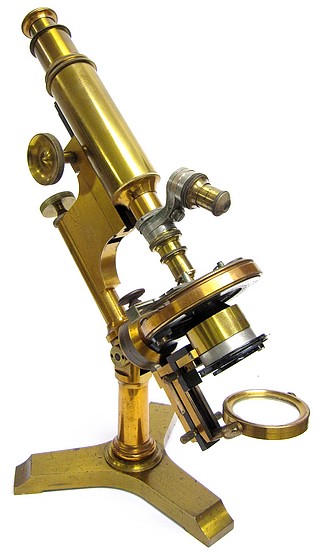
Bausch & Lomb Optical Co. Universal model microscope


Bausch & Lomb Optical Co. Universal model microscope

Bausch & Lomb Optical Co. Universal model monocular microscope. Serial 6454, c. 1889

Bausch & Lomb Optical Co. Universal model monocular microscope. Serial 6454, c. 1889 in case


Some additional information, extracted from the literature, is supplied below.


Extracted from: Behrens Guide to the Microscope in Botany, 1885

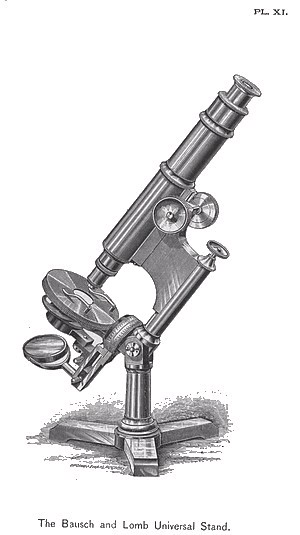
This stand, made by the Bausch and Lomb Co., is represented 1/2 natural size in Plate XI. It comprises the same general features as the one last named, but by a slight increase of distance between the stage and the table sufficient space is secured to admit the use of the largest illuminating or polarizing apparatus, etc., that is usually employed on the largest stands. In fact there is scarcely any of the accessory apparatus of the highest-priced microscopes that cannot, with a few slight modifications in non-essential particulars, be easily and efficiently combined with this. This stand can be obtained as shown in the cut, in a very simple and inexpensive style; but it is capable of a much higher development. It has been constructed, for the use of the writer, with the addition of lengthening mirror bar, graduated draw-tube for use in micrometry and in drawing to scale at any desired amplification, centering adjustment to stage, and graduated rotation of the same, centering substage moved vertically with rack and pinion, and graduated fine adjustment screw with index point, for use in measuring approximately the thickness of objects or cover-glasses. It is named by the makers the "Universal," from the belief that it is possessed of the working capacity of the most elaborate stands. The stage is well adapted to the use of a glass sliding stage; and a mechanical stage moved in all directions by special mechanism can be added if desired.


From the B&L Price list, 7th ed., 1882:


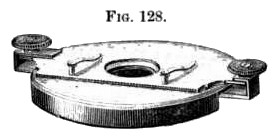
Bausch and Lomb Optical Co.'s Glass Stage and Slide-carrier.This (Fig. 128) is intended as a substitute for the mechanical stage to a certain extent. It consists of a polished plate of glass, incased in a brass ring, which clamps on the circular stage. The slide-carrier, which moves on it, consists of a light metallic plate, and has protruding from its lower surface four small points; at its two ends are prolongations, which are bent downward and inward, and, acting as springs, press against the lower surface of the glass. As the contact between glass stage and slide- carrier is only in these six points, friction is reduced to a minimum, and the action of the latter, although firm, is smooth and steady. It is claimed that it enables work to be done with far more facility than in the ordinary brass stage, where the entire surface of the slide bears on it, and that it is altogether more agreeable. The slide- carrier is provided at each end with small milled heads for manipulation, and has spring clips and a stop for Maltwood finder.

From the  Journal of the Royal Microscopical Society.

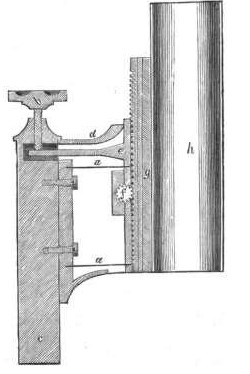
Bausch and Lomb Optical Co.'s Fine Adjustment. Fig. 126 represents the original of the fine-adjustment referred to at Vol. I. (1881) p. 110. Two strong parallel blades of finely tempered steel, a a, are securely fastened on one end to the back of case Fig. 126. d, on the other to the arm e, which carries the rack and pinion, b shows the micrometer screw, which is fitted to the upper part of the upright arm c, f is the pinion, g the rack and slide, h the tube. Two screws fasten the adjustment case d to the pillar c. An arm projects from the part e and passes into a recess in the pillar c. The springs support the entire body, and as their tension is upward, the projecting arm bears continually against the micrometer screw b, and it is evident that tho distance traversed by tho screw involves the same movement of the arm e, and consequently the body. The only points of contact are at the ends of the springs a, a, where they are fastened respectively at d and e, and on the micrometer screw, and as in the former there is absolutely no friction, there is no wear; while that which may eventually take place in the latter is taken up by the force of the springs.The points of excellence claimed by the makers for this adjustment over all others, are the following: 1. It moves the entire body. 2. It is extremely sensitive and direct. 3. It has no lateral motion or displacement of the image, while adjusting. 4. It has absolutely no lost motion. 5. It can in no manner deteriorate.

Fig. 126


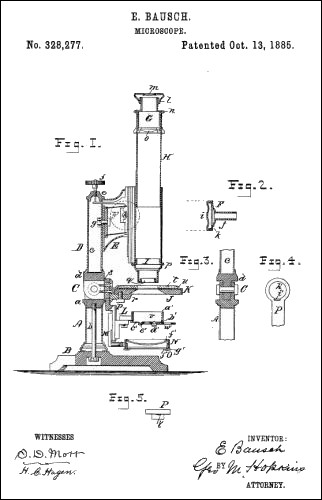
Copies of the 1876 and 1885 patents can be obtained by clicking on the images below:

US patent 182919

Gundlach microscope patent us182919

US patent 328277

Bausch and Lomb microscope patent us328277

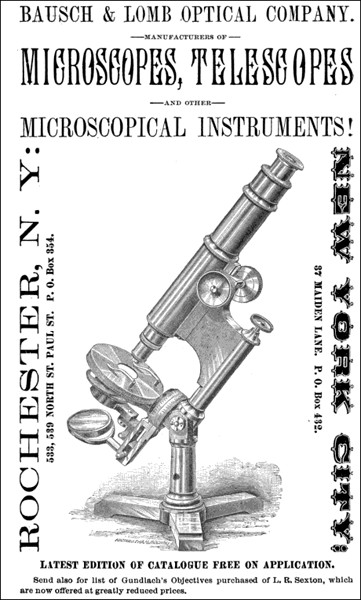
1880 advertisement

An 1889 Bausch & Lomb  advertisement

email : wissnera@verizon.net

www.antique-microscopes.com