|
|
|
 |
|
|
|
|
|
 |
|
|
|
|
Camera ludica |
|
Bausch & Lomb Optical Co. #7741
"The Model" microscope, c.1890
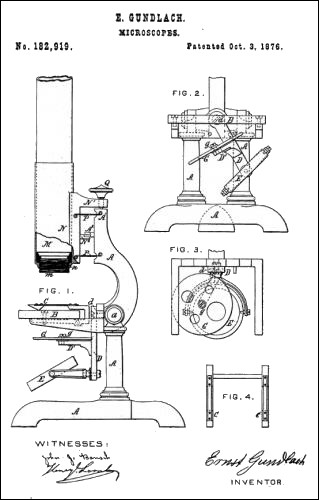
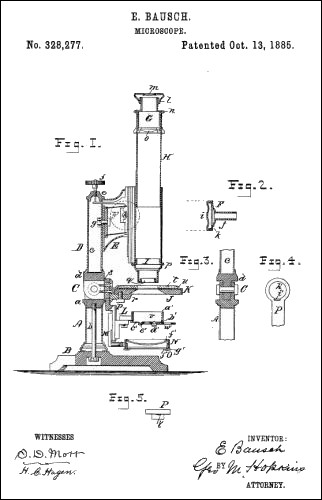
Pat. Oct. 3, 1876 and Oct 13, 1885
|
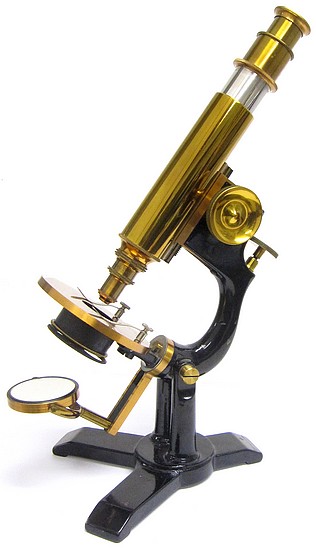
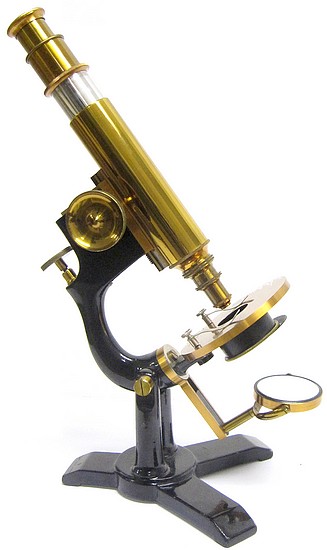
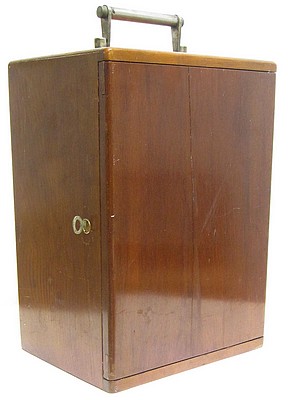
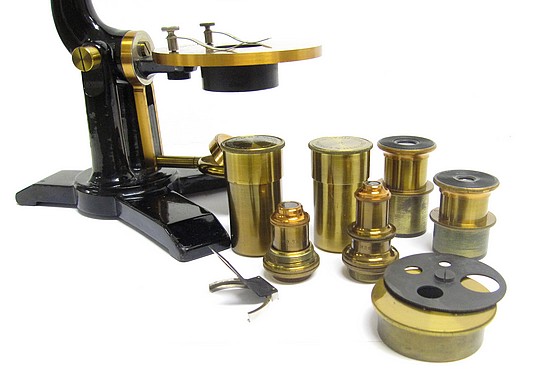
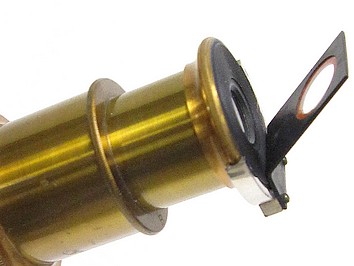
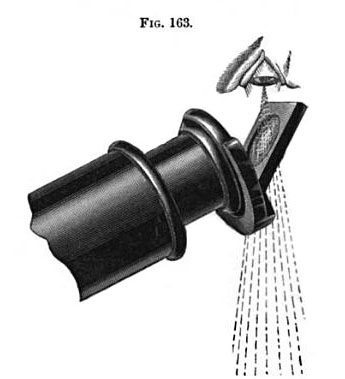
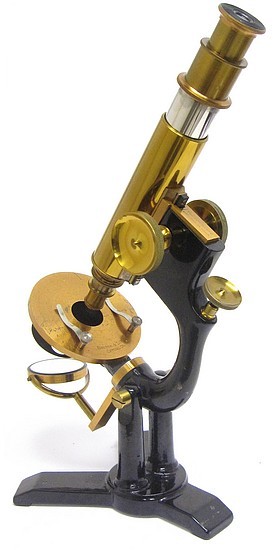
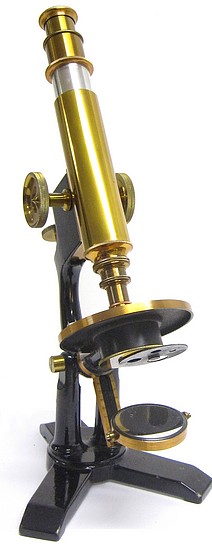
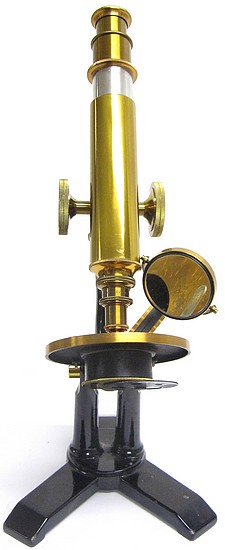
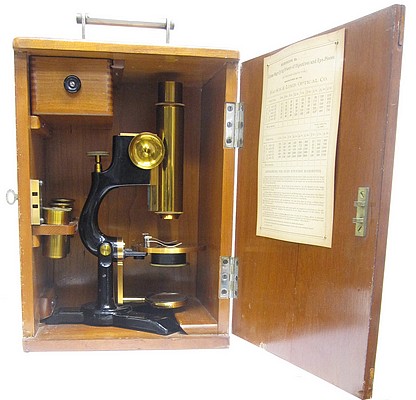
The microscope is signed on the stage: Bausch & Lomb Optical Co. Stamped on the inside bottom the case is the serial number 7741 corresponding to a date of manufacture of 1890. On the upper part of the limb are the two patent dates shown above (click to download the patents). It is an example of the B&L "Model" microscope. The microscope is constructed in bright lacquered brass and black japanned iron. It stands about 13-inches in height in the inclined position as shown in some of the photos with the nickel plated drawtube partially extended. The drawtube has a Society Screw on the lower end to accommodate very low power objectives and other accessories. The coarse focusing is by rack and pinion and the fine focus utilizes a micrometer screw, which operates the patented B&L mechanism. The round lacquered brass stage has the two stage clips. The substage consists of a wheel of diaphragms. The mirror is adjustable on its swinging arm and is double sided with plane and concave glasses in good condition; it can be positioned above the stage to illuminate opaque objects. The microscope is supplied with two B&L eyepieces (marked B and D) and two B&L objectives (marked 1/5 and 3/4) with their brass canisters. Also found with the microscope is the B&L camera ludica, which can be attached to either eyepiece. The microscope is in very good mechanical condition. All adjustments are in working condition. The optics are also in fine condition. The lacquered brass surface finish is original and is in pristine condition as is the japanned iron base and limb. The wood storage box with nickel plated brass handle, internal draw (containing some blank slides and cover slips), magnification chart, lock, and key is in nice condition with a good surface finish; there is a crack on the front door due to wood shrinkage, but it is nevertheless in solid condition.
SOLD Please include $35.00 for postage and insurance for shipping within the continental US; at cost if shipped elsewhere.
|
|
|
|
|
|
|
|
|
|
|
|
|
|
|
Camera ludica |
|
|
Extracted from the Chas. Truax & Co, catalog, 1890:
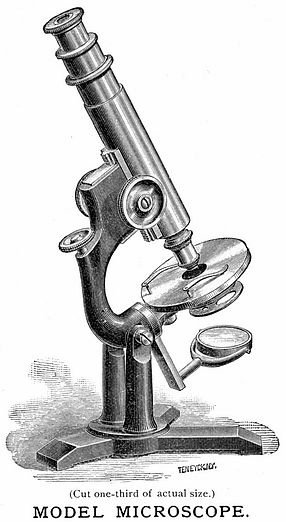
MODEL MICROSCOPE. This microscope was originally constructed in compliance with a generally expressed demand for a simple, low-price and well-made instrument, which is adapted to every grade of work, and claim that in it we have a model which possesses, in an eminent degree, these qualities. Probably no low-price instrument has ever been offered the public, which has been so favorably received and met with such ready sale as this. It is of chaste design, its parts arc all calculated to bear the strain of every-day work, and on this account and because of its simplicity, it may be used by inexperienced hands, without detriment or injury to it. This microscope especially recommends itself by requiring a smaller pecuniary outlay than any of similar construction, and may be supplied with valuable additions, such as our revolving and glass stages, mirror-bar with adjustable mirror and sub-stage, all of which greatly increase the efficiency and add but little to the price of the instrument. The tripod base, pillars and arm, are neatly japanned; the axis is arranged with strong bearings to allow inclination of the body to any angle. Coarse adjustment is by perfect rack and pinion, provided with tightening screws; fine adjustment by a delicate micrometer screw, acting on our patent movement. As at present constructed, the arm is considerably lengthened to allow the more convenient use of low-power objectives, as well as the double, triple and quadruple nosepieces. The stage is of brass, circular in form, thin to allow great obliquity, but of sufficient strength to be firm under manipulation. Attached to its lower side is a sub-stage ring and revolving diaphragm, both of which maybe removed. The main tube is arranged with cloth lining, in which the draw-tube is fitted; it is provided with the society screw to receive low-power objectives, amplifier or analyzer of polariscope. Plane and concave mirrors are of large size, adjustable on the mirror-bar, which is a feature possessed by few low-price instruments, although it is of considerable importance, from the fact that a change in the distance of the light requires a corresponding adjustment of the mirrors; the mirror-bar swings on a large bearing (the axis of which lies in the plane of the stage) to any obliquity below and above the stage, the latter for the illumination of opaque objects. |
 |
 |