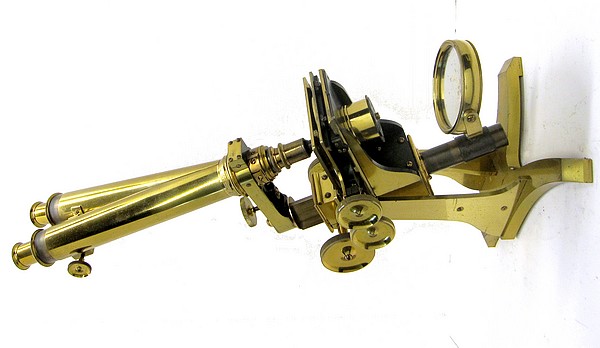
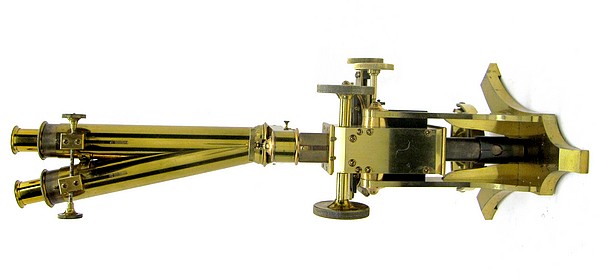
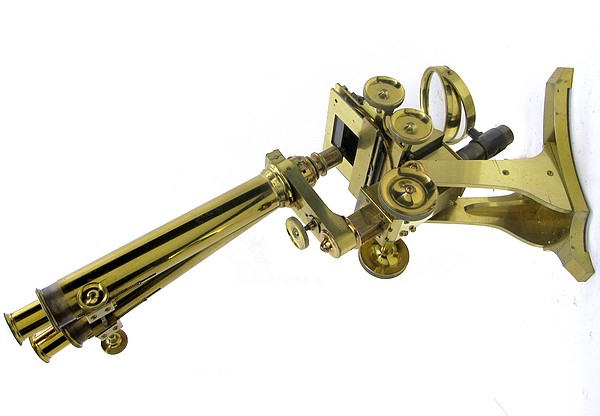
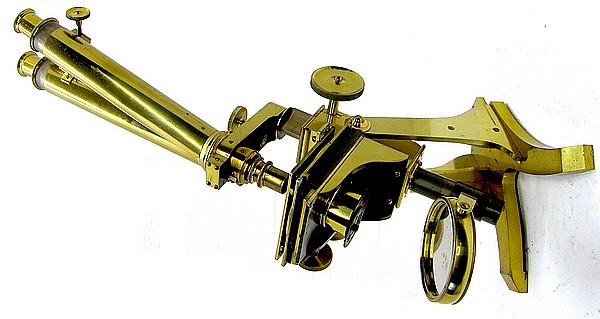
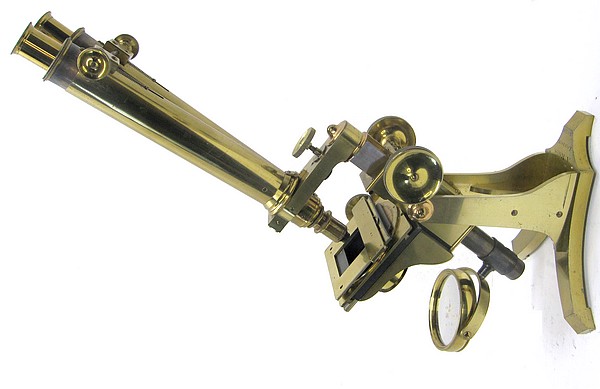
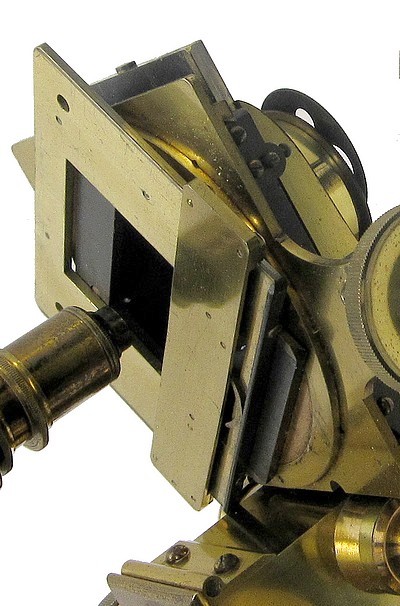
The microscope is based on a design originally developed by Andrew Ross in 1843.
Constructed entirely of brass, it stands approximately 20-inches in height
in the upright position as shown in the photo. Coarse focusing is achieved via a rack-and-pinion mechanism,
while fine focusing is controlled by a micrometer screw positioned at the top of the bar-limb.
This screw engages a long lever, which in turn adjusts the nosepiece of the microscope.
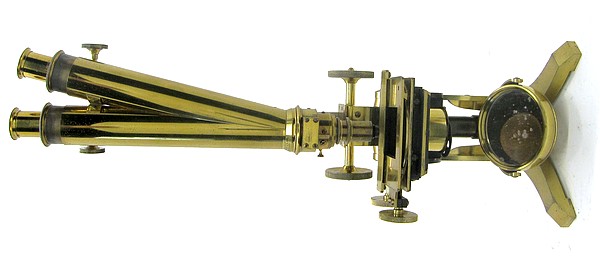
There is a rack and pinion adjustment for the interocular distance. The microscope is
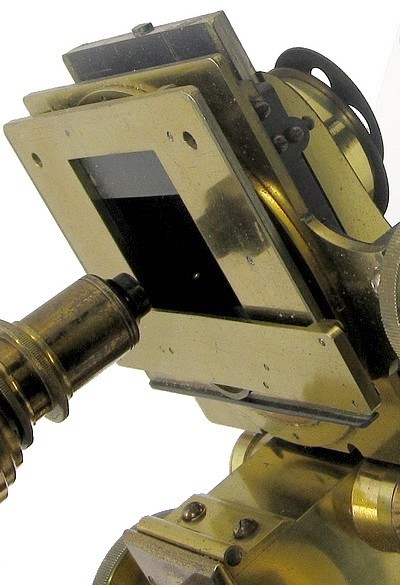
equipped with a mechanical stage having orthogonal motions and an adjustable slide
holder. The substage, which can accommodate various accessories, consists of a cylindrical holder attached to the underside of
the stage utilizing a slide-in mounting. The top stage plate is capable of rotation through the optical axis.
The 3¼ inch diameter mirror is double sided with plane and concave glasses. The microscope was found without its storage case.
It is supplied with a single objective, a matched pair of eyepieces, and a substage aperture disc.
Originally manufactured as a monocular microscope in 1847, this microscope
was later factory upgraded to a binocular after Francis Wenham introduced his revolutionary
binocular system in 1860. This stereoscopic modification quickly gained
widespread popularity, prompting many owners of monocular microscopes to
have their instruments upgraded to a binocular by the manufacturer. This
practice was often seen with microscopes produced by Andrew Ross, as
demonstrated by the instrument featured on this page. The converted binocular
tubes bear their own signature, “WENHAM’S BINOCULAR, by Ross, London.”
On another website, there is an
example of this model that retains its original monocular tube (see the second microscope on the page).
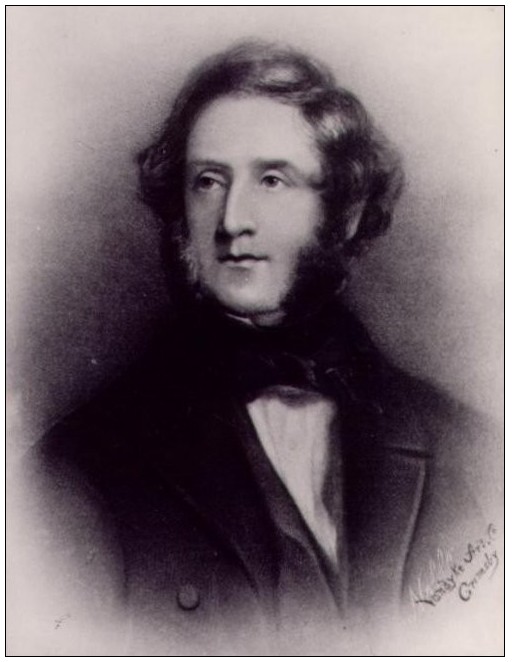
George Tomline (1813-1889)
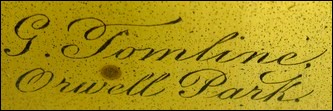
On the base of this microscope, just above the Ross signature, is engraved
the name of its original owner: G. Tomline, Orwell Park.
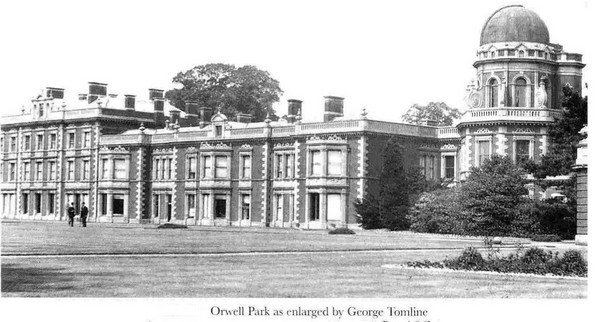
George Tomline (1813–1889), commonly referred as Colonel Tomline, was a Member of Parliament
for over thirty years and one of England’s wealthiest men. In 1848, he acquired the Orwell
Park estate, where he pursued his interest in science, particularly astronomy. To
further this passion, he commissioned the construction of an observatory on the grounds,
purchased equipment, and hired a professional staff to operate it.
The image below shows the estate's main buildings, with the observatory’s dome visible in
the top right corner.
The observatory remains in use today.
Evidently, Tomline also had
some interest in microscopy as evidenced by the microscope shown on this page.