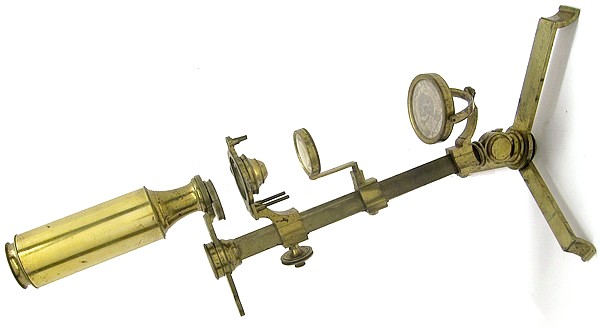
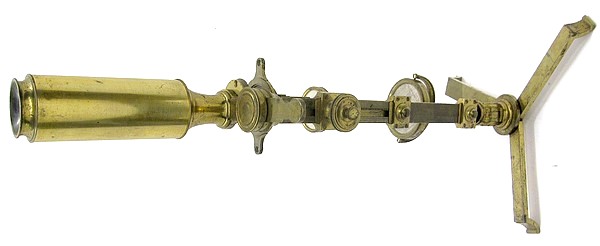
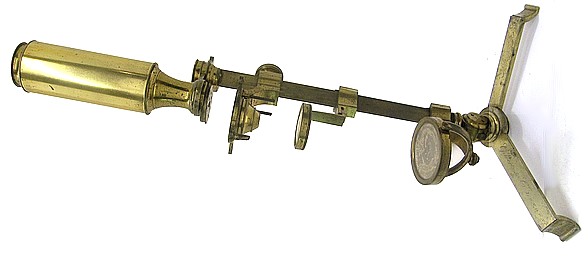
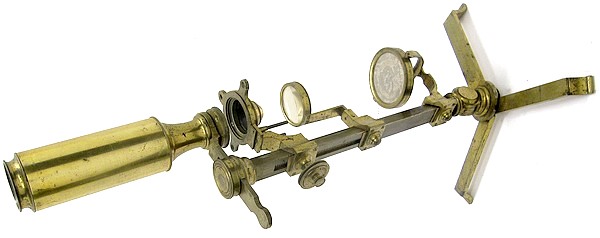
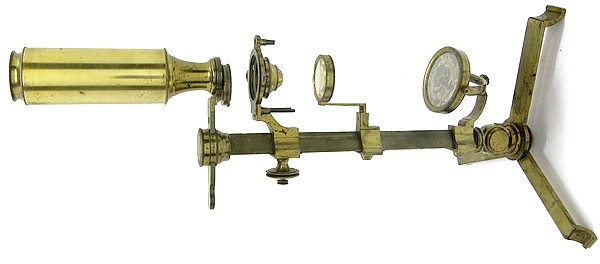
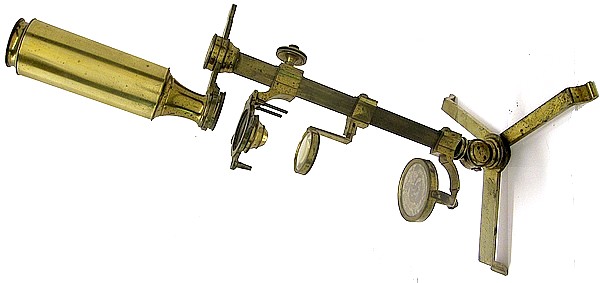
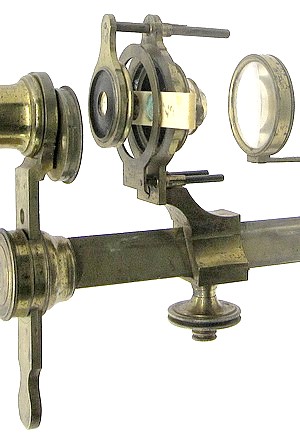
This microscope is signed on one leg of the tripod base "Gilbert & Co., London". It dates from the late 18th to early 19th century. The microscope stands 17½ inches tall when in the upright position. It features a triangular-shaped pillar on which the mirror, substage condenser, stage, and body tube are mounted. The instrument has a folding tripod base, above which is an inclination joint.
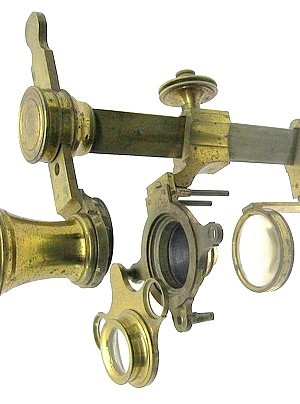
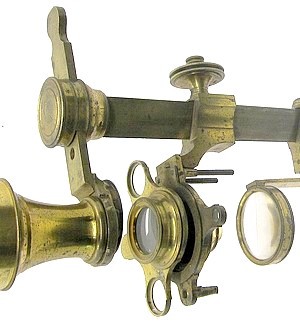
The stage is focused by rack and pinion. Attached to the back of the focusing knob is a smaller knob that adjusts the tension between the pinion and the rack. The double-sided mirror and the substage condenser lens slide along the pillar. The condenser includes a mechanism that allows it to be moved out of the optical path when not in use.
The body tube is equipped with four lenses. Two are used in the eyepiece, one is mounted above the nosepiece, and the last is positioned within the body tube. This arrangment of the tube lenses was first introduced by Benjamin Martin. The tube has full aquatic movement, allowing it to move in and out as well as to swivel.
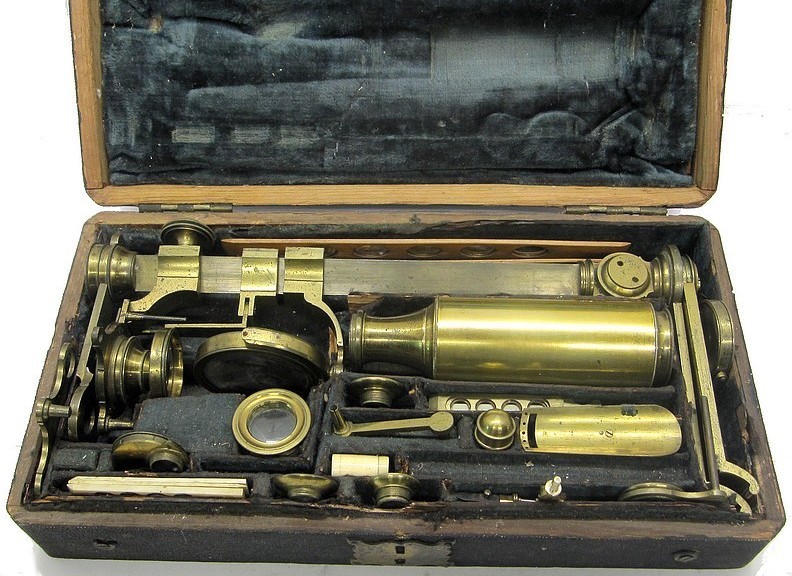
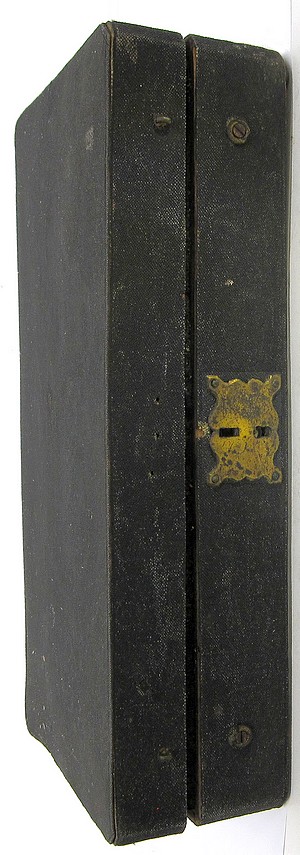
The microscope and its accessories are housed in a fish-skin-covered case with dimensions 13½ × 6¾ × 3⅛ inches. The case is fitted with a dark green plush interior and includes compartments for the various accessories.
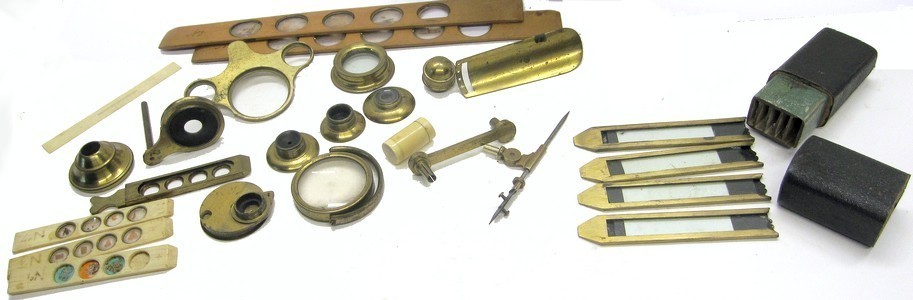
Among the accessories are six numbered objectives housed in a rotating nosepiece. Also included are three objectives with Lieberkühn reflectors, which can be used either with or without the compound tube, as well as a high-power objective with a dust cap that is intended for use without the compound tube. A separate Lieberkühn, mounted for stage use, can be employed with the objectives in the rotating nosepiece. Additional accessories include a fish plate, a live box, a substage light cone, a talc box, a stage forceps, a stage-mounted accessory holder, a brass wet slide, a stage micrometer, and a stage-mounted bullseye condenser (lacking its mounting pin). There is also a supplementary secondary stage with three apertures, three ivory sliders each containing multiple specimens, and two large wooden slides. Housed in a separate fish-skin-covered box are four brass-bound glass slides with rulings, numbered 50, 100, 500, and 1000. The numbers likely refer to the number of lines per inch.
This microscope is based on a final version of a design initially introduced by Benjamin Martin (1705–1782), which he called the “Universal” microscope. See this example located at the Science Museum. Following Martin’s death in 1782, his designs were widely copied by several other English makers. A closely comparable microscope to the one shown here, also signed Gilbert & Co., is known, although it lacks the substage condenser. The same reference also includes a brief history of the Gilbert firm. John Bleuler (1756–1829) is likewise known to have sold a very similar Universal microscope.
The firm used the name Gilbert & Sons during the years 1806-1818. Prior to that, the firm was called Gilbert & Wright or Gilbert & Co.