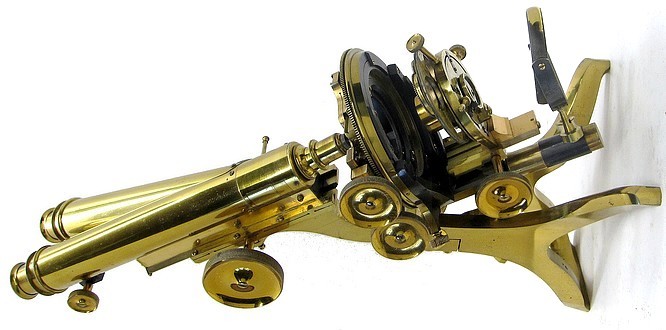
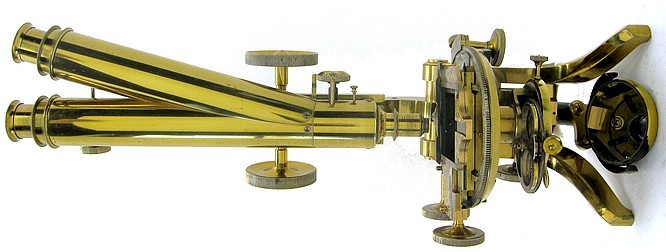
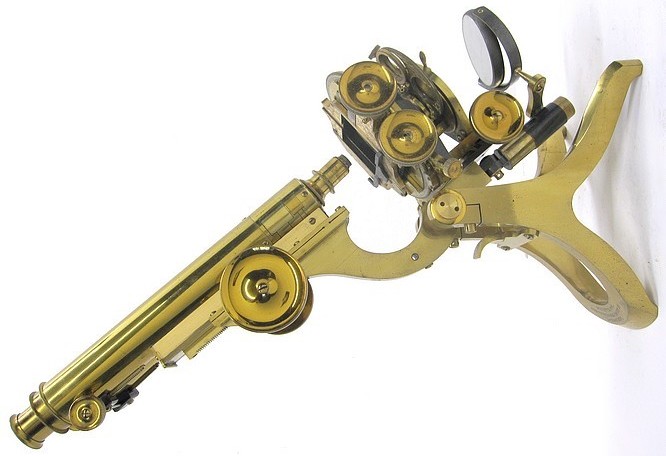
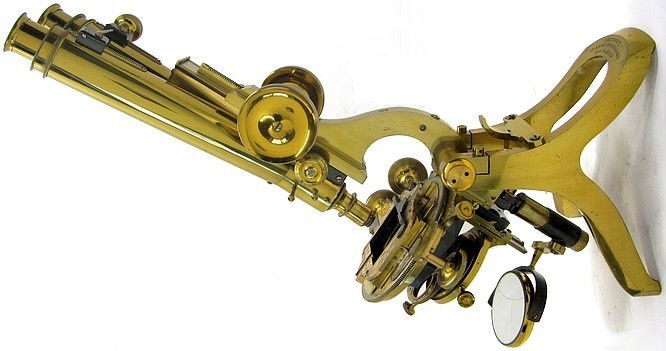
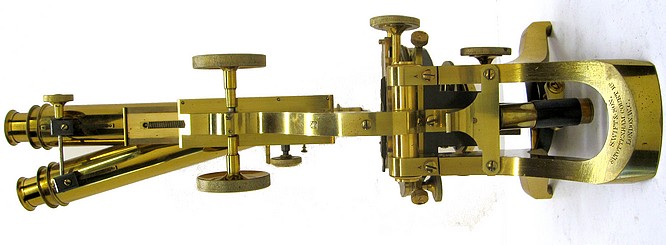
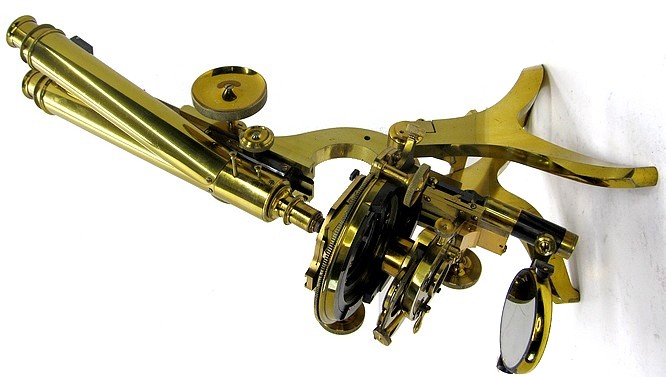
In the 1892 Swift & Son catalog, this microscope was referred to as the 'Best Challenge Microscope', No.2. Other, less elaborate members of the Challenge series are referred to as Models A, B, and C or as Models No.5, No.4, and No.3, respectively. Also included in the Challenge series is what is described as the 'Large Presentation Microscope', No. 1, which is nearly identical to, though slightly larger than, the microscope shown here. An example of Model A also resides in this collection.
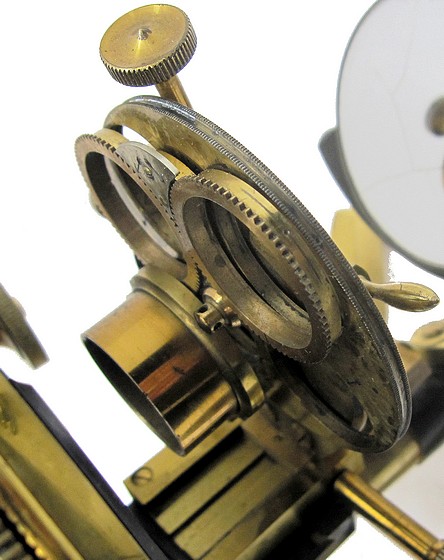
The microscope is constructed entirely of lacquered brass. It measures 15-inches in height when fully closed down, with the eyepieces removed. When set up for use and inclined as shown in the images, it measures 17.5-inches tall. The microscope came to me without the storage case. It is supplied with two eyepieces and one objective. The sub-stage holds Swift’s Universal Condenser, which is missing its optical elements. Above the tube-slide holding the Wenham prism is another slide holding an analyzing Nicol prism.
The following description of this model was extracted from the 1892 Swift & Son catalog:
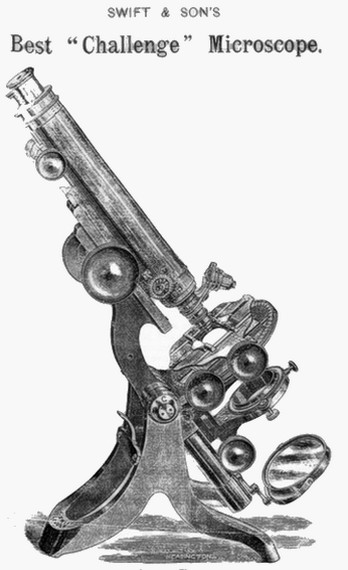
No.2—This instrument is similar in mechanical construction to No.1 but of smaller size.
COARSE ADJUSTMENT by spiral rack and pinion; Swift’s “Climax” fine adjustment, which is perfectly steady and reliable with the highest magnifications.
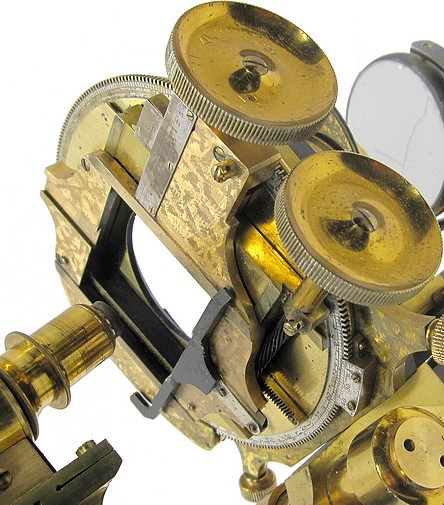
CIRCULAR ROTATING STAGE moved by rack and pinion, which can be put out of gear for rapid rotation by hand, divided on the edge to 360°. Rectangular mechanical movements; the stage plates divided on silver to 1/20th of an inch, with vernier reading to 1/1000th, to serve as a Finder or for measurements. Sliding object holder with tension springs and clamps. Centering adjustments, so that the whole stage can be made to rotate truly with any objective.
SUB-STAGE with complete adjustments for focussing and centering, and rotatory movement by circular rack and pinion. The whole slides in transverse dovetailed grooves, and can be instantly removed with all its fittings when not required, thus leaving the space under the main stage perfectly free for any desired manipulation. The same arrangement applies to the other instruments of the “Challenge” series.
LARGE FIRM TRIPOD BASE; extra, large mirrors mounted on double crank arm. Sliding fitting for analyser of polariscope..
PRICE: as Monocular with two eye-pieces in plain cabinet ... ... £27 10 0
with Binocular body, having rack adjustment to the draw-tubes, which are graduated, and two pairs of eyepieces, A and B, in cabinet ... ... £31 10 0
The microscopes in the "Challenge" series have Swift's novel side-mounted fine adjustment mechanism. It is described in the Journal of the Royal Microscopical Society, 1881 as follows:
"The principal novelty is the fine adjustment (Fig. 43, nearly full size). A is a brass plate having short angle-bearings at either end sliding in the grooves B B and carrying at the lower end a ring into which the objectives are screwed. A spiral spring C presses down the plate A. The focussing is by means of the fine screw worked by the milled head F, the point of which acts upon the trigger-shaped lever D (attached to the side), which pushes against the small metal disk E (mounted on A and rotating on a pinion to diminish friction) and this lifts up the slide A against the pressure of the spiral spring above. The ring carrying the objective is quite independent of the microscope-body, and should the slide A be found to work too easily or the reverse, the bearings can be readily adjusted by the capstan screw-heads shown at the side.

An improved application of this fine adjustment has since been devised, as shown in Fig. 44; the modification consisting of a wedge-shaped lever worked by the fine-focussing screw (against a short spiral spring) and acting on the slide A by means of the two small revolving disks attached loosely by a triangular fitting to the pinion at E. By making the slope of the wedge very acute, and the thread of the screw very fine, the focussing movement is rendered unusually delicate. This latter form of fine adjustment is designed to be applied to more expensive Microscopes".
Home-Antique Microscopes Site Index
email: wissnera@verizon.net
